
Hagia Sophia was completed as a Byzantine cathedral in 537 under Emperor Justinian, became a mosque in 1453 after the Ottoman conquest, opened as a museum in 1934, and returned to use as a mosque in 2020.
Source: official figures published by the Turkish Ministry of Culture & Tourism / Directorate of Religious Affairs (muze.gen.tr), verified June 2026.
Justinian's basilica (537)
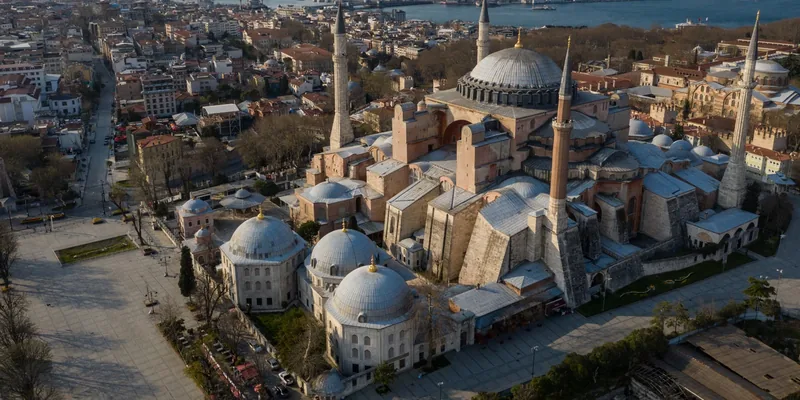
The church you see is the third on the site. Earlier basilicas burned in riots; Justinian rebuilt on a scale never attempted before, dedicating the new Hagia Sophia — "Holy Wisdom" — on 27 December 537. For almost a thousand years it was the largest cathedral in the world and the heart of Eastern Christianity.
Conquest and conversion (1453)
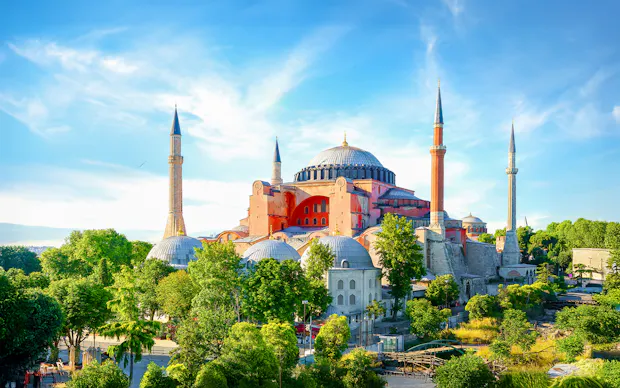
When Mehmed II took Constantinople in 1453, Hagia Sophia became an imperial mosque. The Ottomans added minarets, a mihrab and minbar, and later the great calligraphy medallions, while plastering over the Christian mosaics rather than destroying them — which is partly why so many survive.
| Year | Event |
|---|---|
| 532–537 | Built for Emperor Justinian; dedicated 27 Dec 537 |
| 1453 | Converted to a mosque after the Ottoman conquest |
| 1500s–1700s | Minarets, medallions and Ottoman additions |
| 1934 | Declared a museum by the Republic of Türkiye |
| 1985 | Inscribed on the UNESCO World Heritage List |
| 2020 | Reopened for worship as a mosque on 10 July |
Museum years (1934–2020)
In 1934 the young Turkish Republic turned Hagia Sophia into a museum, and conservators began uncovering the hidden Byzantine mosaics. For most of the 20th century it stood as a symbol of shared heritage and one of the world's most studied buildings; in 1985 it joined the UNESCO World Heritage List as part of Istanbul's historic areas.
A mosque once more (2020)
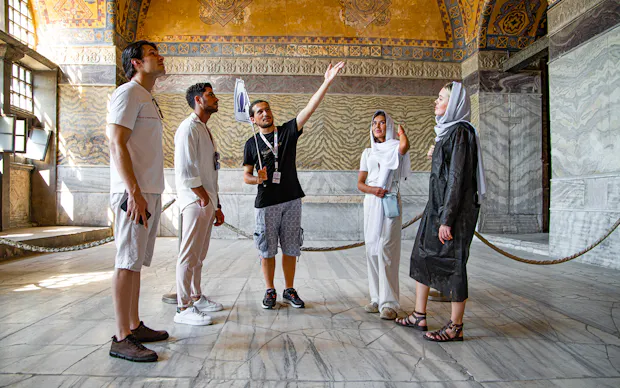
On 10 July 2020 Hagia Sophia reopened for Muslim worship. Visitors are welcome outside prayer times; since January 2024 tourists access the historic upper gallery on a €25 ticket, while the ground floor serves as the prayer hall. See tickets and prices for the current rules.
📜Why so many lives?
Hagia Sophia sat at the meeting point of two empires and two faiths. Each era added to it rather than erasing the last, which is why a single room holds Byzantine mosaics and monumental Islamic calligraphy side by side.
Walk through 1,500 years
Stand under the dome that has crowned emperors and called the faithful to prayer.
See the history for yourself
The dates come alive once you're under the dome. Check opening hours, then use our inside guide to find the mosaics each century left behind.
Frequently asked questions
How old is Hagia Sophia?
The current building was completed in 537, making it nearly 1,500 years old. It is the third church to stand on the site.
When did Hagia Sophia become a mosque?
It first became a mosque in 1453 after the Ottoman conquest, served as a museum from 1934, and returned to use as a mosque on 10 July 2020.
Who built Hagia Sophia?
It was built for the Byzantine emperor Justinian I by the architects Anthemius of Tralles and Isidore of Miletus, between 532 and 537.
Is Hagia Sophia a UNESCO site?
Yes. It was inscribed on the UNESCO World Heritage List in 1985 as part of the Historic Areas of Istanbul.
Can tourists still visit now that it's a mosque?
Yes. Tourists visit outside prayer times, with €25 access to the upper gallery, while the ground floor is reserved for worship.